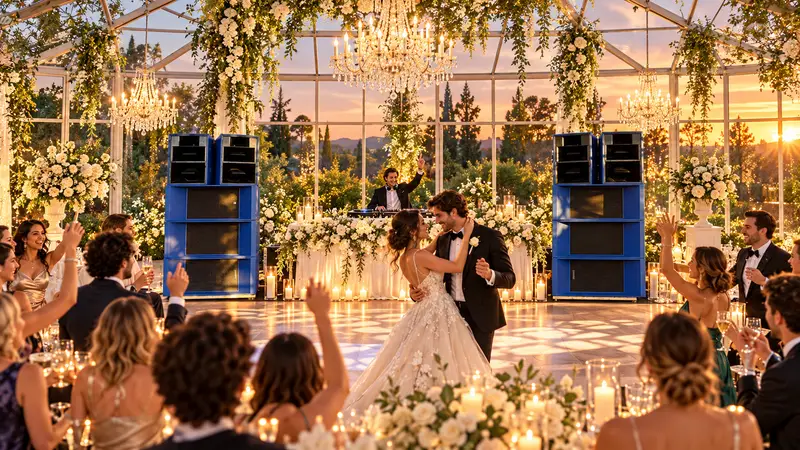
A wedding DJ runs the reception from entrance to last dance: playing music, MCing every announcement, keeping the night on schedule, and reading the room to decide what plays next. The music is the visible part. The scheduling and the room-reading are the actual job.
The job starts weeks before the wedding
Before the DJ ever touches a microphone, there’s a planning call or a form covering the songs that matter: your entrance, your first dance, the parent dances, and anything you absolutely do not want played. A DJ who skips this step is guessing on your wedding day. A good one has your list memorized before cocktail hour starts.
This is also when the timeline gets built. Cocktail hour into dinner, dinner into toasts, toasts into the first dance, first dance into open dancing, open dancing into the last song. Every wedding’s version of that sequence is a little different, and the DJ is the one holding the master copy on the day.
During cocktail hour: setting the tone, not the volume
Cocktail hour music is background, not a performance. The job here is picking music that fits the mood without competing with conversation, and being ready to instantly shift into “reception starting” mode the moment the wedding party is ready to be introduced.
The introduction: the DJ’s first on-mic moment
This is usually the first time guests hear the DJ’s voice, and it sets the tone for how the rest of the night feels. A flat, generic introduction reads as an afterthought. A DJ who learned names, pronunciations and the right amount of energy for your specific crowd makes the room feel like it’s actually your wedding, not a template.
Dinner and toasts: technical work that has to be invisible
Toasts are where sound quality actually gets tested. A wireless mic that cuts out, feedback that makes someone wince, or a best man who can’t be heard past table six turns a heartfelt moment into an awkward one. This is the part of the job that’s pure equipment and pure attention: watching mic levels, watching who’s about to stand up to speak, and staying two steps ahead of the room.
The first dance and family dances
These moments run on a cue, not a feeling. The DJ needs the right song loaded, the right volume for a room that just went from chatting to watching, and the timing to bring the lights or the moment in exactly when it should land. This is usually rehearsed in the planning call, not improvised on the night.
Open dancing: reading the room in real time
This is where “just playing songs” turns into an actual skill. A DJ watches who’s on the floor, who just sat down, and what request just came in, then decides what plays next based on all of it at once. The same song that fills a floor at one wedding can empty it at another, depending on the crowd, and a good DJ adjusts on the fly rather than running a fixed playlist.
The DJ is also running the sound system
At most weddings, the same person and the same equipment cover the microphones, the toasts, the dinner music and the dance floor. That’s one system tuned once, instead of a ceremony vendor, a reception vendor and a separate sound company all showing up with their own gear. See DJ or live band for your wedding if you’re still deciding between the two, and what a wedding DJ costs in Austin for real numbers.
A sample hour-by-hour rundown
| Time | What’s happening | DJ’s job |
|---|---|---|
| Cocktail hour | Guests mingle | Background music, mic check |
| Reception start | Guests seated | Wedding party introductions |
| Dinner | Meal served | Low-key music, watch for toast cues |
| Toasts | Speeches | Clean mic handoffs, no feedback |
| First dance | Couple’s moment | Cued song, room-appropriate volume |
| Open dancing | Dance floor | Reading the crowd, taking requests |
| Last song | Night winding down | Planned send-off moment |
What to ask before you book
If you’re comparing DJs, our 25 questions to ask a wedding DJ covers the specifics: how they handle the MC role, what happens if a mic fails, and how they take requests without wrecking the timeline.
Ready to lock a date
Every wedding package includes a DJ and MC, our own sound system, setup and teardown, so the job described above comes standard, not as an upgrade. See our three wedding DJ packages or check your date and book online.
A good DJ runs the room. You just get to enjoy it.
Quick
answers.
Does the wedding DJ act as the MC too?
At most weddings, yes. The DJ introduces the wedding party, announces toasts and traditions, and keeps the reception moving from one moment to the next, in addition to playing music.
How early does the DJ need my music preferences?
A planning call or online form a few weeks out is typical. That's when you share must-plays, do-not-plays, and the songs for key moments like the first dance and entrance.
Can the DJ also handle ceremony sound?
Yes, if the package includes it. A single system and DJ for both ceremony and reception means one setup, one soundcheck and one team handling your whole day, instead of two vendors and two systems.
What if we want a live band moment and a DJ?
Common, and it works well. Tell your DJ ahead of time. Most reception timelines have room for a band during dinner or cocktail hour with the DJ taking over for the dance floor.