
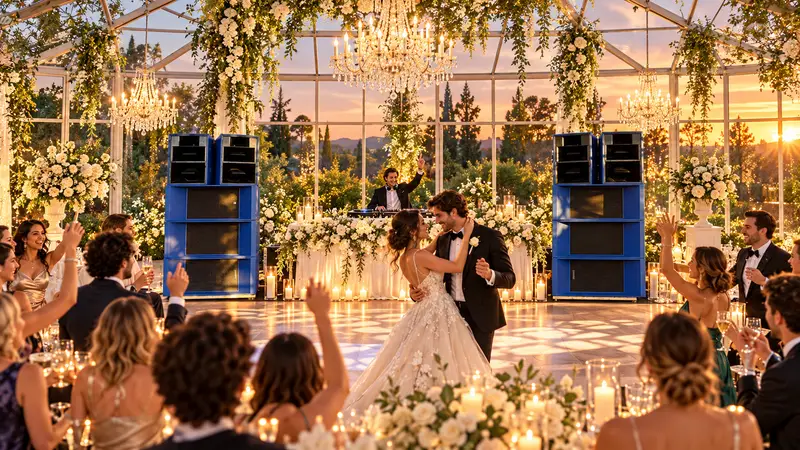
People remember how a ceremony felt: the light, the faces, the first look. They only remember the sound when it goes wrong. A whispered vow that never reaches row four, an officiant fighting the wind, a processional song that starts halfway in.
Good ceremony audio is invisible. Here is how we make it that way.
What ceremony sound needs
A ceremony is almost the opposite of a party. It is quiet, spoken and precise.
- Clarity over power. You need to hear soft voices, not shake the ground.
- Reliable wireless. Microphones that do not cut out, pop or feed back.
- Clean cues. Music that starts on the right beat and ends on time.
- Discreet gear. Speakers and cables that stay out of your photos.
The ceremony audio kit
Microphones
- Officiant: a wireless lavalier that clips on and stays hands-free, or a handheld.
- The couple: if you want your vows amplified, small wireless microphones for each of you.
- Readings: a handheld or a mic on a stand for anyone who reads.
- Spare: batteries and a spare mic ready.
Speakers
Small, clean speakers placed to cover every row without pointing at the microphones. We aim them, tune them and test them before guests arrive.
Music
- Prelude: soft music as guests arrive and are seated
- Processional: the wedding party, then the entrance
- During: unity music, a musician’s cue or a song
- Recessional: the exit song
We run the cues from a prepared playlist, so nobody has to fiddle with a phone.
Outdoor ceremonies
Austin is famous for beautiful outdoor spaces, and outdoor sound is harder than it looks.
- Wind carries sound away and buffets microphones. We use windscreens and place speakers on the right side of the audience.
- Open air has no walls to help. The system needs to be sized for the space, not the headcount.
- Ambient noise from traffic, birds and cicadas competes with quiet speech.
- Power may be far away. We plan the cable runs or the power source.
That is why a lawn ceremony often needs a bigger system than an indoor chapel with the same number of guests. Read more in wedding sound system rental: what you actually need.
Indoor ceremonies
Churches, ballrooms and event spaces bring reflections. Hard surfaces bounce speech into mush. We place and tune the speakers to keep vowels clear, which matters much more than volume.
When the ceremony and reception are in different places
We plan the move: a lighter ceremony setup that comes down during cocktail hour, or two systems so nothing has to be rushed. Your timeline decides.
A simple ceremony audio timeline
| When | What happens |
|---|---|
| 2 hours before | Load-in and speaker placement |
| 1 hour before | Mic check and music cues tested |
| 30 minutes before | Prelude music starts |
| Ceremony | Processional, vows, unity moment, recessional |
| After | Break down or move to the reception |
Common ceremony scenarios
The lawn or garden ceremony
Open air, wind, a long aisle. We use a small, clean system with a wireless lavalier for the officiant, place speakers to cover the far rows and keep the gear out of your photos. See wedding sound system rental: what you actually need for how much system a lawn needs.
The church or chapel ceremony
Hard walls, high ceilings, long reverb. Speech clarity is the problem to solve. Careful placement and gentle levels keep the vows intelligible without an echoing room.
The ranch or barn ceremony
Long distances from the power, dust and wind, and no house sound at all. See ranch wedding DJ.
The small, intimate ceremony
Sometimes no amplification is the right answer. We will tell you honestly if a couple of small speakers and one mic is enough.
Music for the ceremony
- Prelude: soft and warm while guests arrive.
- Processional: the wedding party, then the entrance. Cues are practiced so the song starts on the beat.
- Unity moment: candle, sand, prayer or reading, each with a fitting piece.
- Recessional: the exit song, usually a lift in energy.
- Live musicians: we can mic a violinist, guitarist or singer and blend them with recorded cues.
Tips from a lot of ceremonies
- Rehearse the cue. If the rehearsal is on the schedule, use it.
- Tell your officiant about the mic. They should not cover it with their hand, and they should not turn away from it.
- Have one person in charge. A sound tech who owns the cues beats a friend with a phone.
- Plan the rain. A tent or a room changes the whole setup.
- Test for wind on the day. We adjust placement and gain as conditions change.
Add the DJ and reception
Most couples book us for the ceremony and the party, so the same crew runs the whole night. See wedding DJ Austin or wedding reception DJ.
Get a quote
Tell us the venue, the date, indoor or outdoor, and how many guests. We will spec the ceremony audio and quote it with the reception if you want both.
Every word, every row.
Quick
answers.
Do we need a sound system for the ceremony?
If you are outdoors, in a large room, or have more than a couple dozen guests, yes. Vows are quiet by nature and soft voices disappear without amplification.
What microphones are used for a wedding ceremony?
Most ceremonies use a wireless lavalier or handheld for the officiant, and wireless mics for the couple if you want the vows amplified. A spare is always on hand.
Can you play music for the processional?
Yes. We cue the prelude, the processional, the unity moment and the recessional from your playlist.
Do you handle a ceremony and reception in different locations?
Yes. We plan a second setup or a mobile system with a timeline for the move.