A wedding ceremony sound system is three things working together: a microphone that lets the back row hear the vows, speakers placed so the sound reaches every seat without feeding back, and a short list of music cues that fire at the right second. Get those three right and nobody in the chairs thinks about audio at all. Get one wrong and it is the only thing anyone remembers.
Here is how each piece actually works, and what to ask for when you book one.
The three jobs a ceremony system has to do
A ceremony is not a scaled-down version of the reception. It is a different job with different priorities.
- Carry quiet speech. Vows are usually said softly, sometimes through tears. The system has to pick that up and project it, not just play it louder.
- Stay invisible. Good ceremony audio does not show up in photos and does not draw attention to itself while it is running.
- Hit a handful of cues exactly. The processional has to start when the wedding party actually starts walking, not a beat late.
None of that calls for a big rig. It calls for the right small rig, placed and run correctly.
Microphones: what to actually use
| Role | Mic type | Why |
|---|---|---|
| Officiant | Wireless lavalier | Clips to the lapel, hands-free, stays put through the whole ceremony |
| Officiant (alternative) | Wireless handheld | Foolproof, easy to pass to a reader or a second officiant |
| Couple reading their own vows | Wireless lavalier, one per person | Keeps both hands free for holding hands, a ring or a card |
| A reading or a musician | Handheld or a mic on a stand | Only needed for the length of that one moment |
| Backup | A second wireless mic, charged and ready | Covers a dead battery or a dropped mic without a pause in the ceremony |
The lavalier is the workhorse of ceremony audio for a simple reason: it is already clipped on and pointed at the mouth before the officiant even thinks about it, so there is nothing to remember to do right in the moment. A handheld is more forgiving of mic technique (it is hard to mess up holding a mic near your mouth) but it has to be picked up and held, which is one more thing for a nervous reader to manage.
One habit fixes most ceremony audio complaints before they happen: tell whoever is speaking to hold the mic close, about a fist’s distance from the mouth, and to talk toward it rather than down at notes on a card.
Where the speakers go
Placement does more work than volume. Two small, full-range speakers on stands, positioned ahead of the first row and angled back toward the seats, cover almost every ceremony setup. The rules that matter:
- Speakers go in front of the microphone, never behind it. A mic that can hear its own speaker will squeal. This single rule prevents most of the feedback that ruins ceremony audio.
- Aim past the back row, not at the front row. Sound falls off with distance. If the back row is comfortable, the front row usually is too.
- Keep the gear out of the aisle sightline. Stands to the side, cables taped down or run around the perimeter, so the photos and the view down the aisle stay clean.
- Skip the subwoofer. Ceremony content is speech and soft instrumental music. A pair of tops is plenty. Subs are a reception tool, not a ceremony one.
Outdoors, the same rules apply with one addition: size the system up. There are no walls to bounce sound back toward the seats, and wind pulls sound and buffets open microphones. A windscreen on the mic and a slightly larger pair of speakers than an equivalent indoor ceremony would need solves both problems. If you are also planning the reception sound, how to choose a PA system for your event covers how outdoor sizing works for the whole day.
Music cues: what actually has to be timed
A ceremony usually runs on four to six music cues, and they are the part most couples underestimate until the rehearsal.
| Moment | What plays | Who triggers it |
|---|---|---|
| Prelude | Soft background music as guests are seated | Starts early, runs on its own |
| Processional | Wedding party entrance, then the main entrance | Triggered on a visual cue: the doors opening or a nod |
| Unity moment | A candle, sand ceremony, prayer or reading | Triggered when that moment begins |
| Recessional | The exit song, usually with more energy | Triggered the instant the couple turns to walk out |
The trick to a clean cue is starting the song from the right point in the track, not just pressing play and hoping the intro lines up with the first step. A song with a long instrumental intro can be started a few seconds ahead of the cue so the vocal or the big moment in the music lands exactly when the couple starts walking. This is rehearsed, not improvised, which is why the ceremony rehearsal matters even when it feels unnecessary.
If you already have a DJ booked for the reception, having that same person or crew run the ceremony cues means the playlist, the gear and the timing are all handled by one team instead of being split between a ceremony-only vendor and the reception DJ. See what a DJ actually does at a wedding reception for how that handoff usually works across the full day.
Indoor vs. outdoor ceremonies
Indoor ceremonies, especially in churches and ballrooms with hard walls, deal with reflections more than volume. The fix is placement and gentle EQ, not more power. Outdoor ceremonies deal with the opposite problem: open air swallows sound instead of bouncing it back, so the same system that would be plenty indoors can feel thin outside. Both situations are solvable with the same small rig. They just need to be set up differently, which is why a venue walk-through or even just a phone call about the space matters more than the gear list.
What a wedding sound system actually needs, in order
- A wireless mic for the officiant (lavalier or handheld), plus a spare.
- Two small speakers, placed ahead of the seats and angled back.
- A cue sheet: prelude, processional, unity moment, recessional, in the order they happen.
- Someone running it who isn’t also trying to be a guest.
- For outdoor ceremonies, a slightly bigger system and a windscreen on the mic.
That list covers almost every ceremony we have run. Bigger weddings add a second reading mic or a musician’s input. Smaller ones sometimes skip amplification entirely, and we will say so if that is the honest answer for your guest count and space.
What’s included when you book with us
Our Full Day wedding package covers the ceremony and the reception with one crew: ceremony sound and a lapel mic for the officiant, upgraded reception sound, and a timeline synced with your planner, for six hours. If you only need the ceremony covered because you already have reception sound handled elsewhere, tell us the venue and guest count and we will spec just that piece.
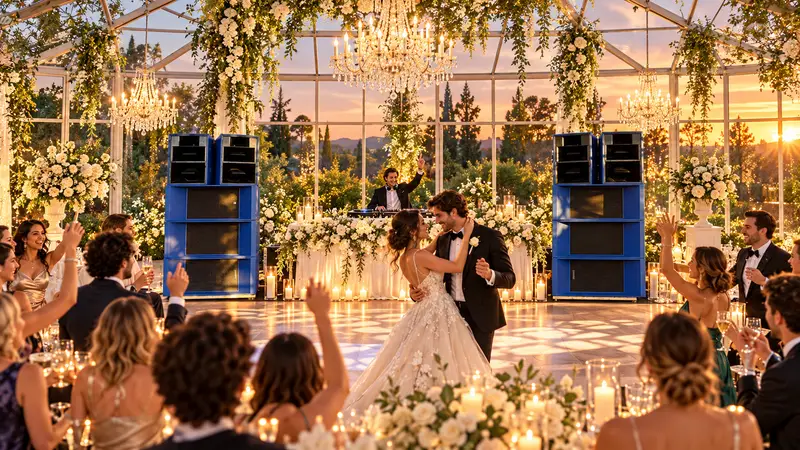
This is also where thirty years of running sound for other people’s biggest days actually shows up. We have cued processionals in church sanctuaries with ninety-foot ceilings and on hillsides with no power for two hundred feet in any direction, and the gear that gets us through both is the same Turbosound Floodlight system we run for every event, reception included.
Ready to lock in your ceremony sound
Tell us the date, the venue and whether the ceremony and reception are in the same spot. We will tell you honestly what microphone and speaker setup your space actually needs. Check your date or send us the details and we will put together the plan.

The best ceremony mic is the one nobody notices.
Quick
answers.
What microphone does a wedding officiant need?
A wireless lavalier is the standard choice because it clips to the lapel and leaves both hands free. A wireless handheld works too and is easier to pass to a second speaker. Either way, it should be wireless so nobody is tied to a stand.
Do ceremony speakers need subwoofers?
Almost never. A ceremony is speech and soft instrumental music, not a dance floor. Two small, clean speakers aimed at the seats do the job. Subwoofers show up later, when the reception dancing starts.
How do music cues work for the processional and recessional?
The songs are loaded in order ahead of time and triggered on a visual signal, usually the wedding party stepping off or the officiant's nod, so the music starts on the right beat instead of a few seconds late or early.
Can the DJ handle both the ceremony and the reception sound?
Yes, and it's the simpler option. One system, one soundcheck and one team cover the vows, the toasts and the dance floor instead of two vendors coordinating on the fly.
What happens if the ceremony is outdoors?
Outdoor ceremonies need more system than the guest count suggests, because there are no walls to help carry the sound and wind can buffet a microphone. Windscreens and a slightly bigger speaker setup handle both problems.