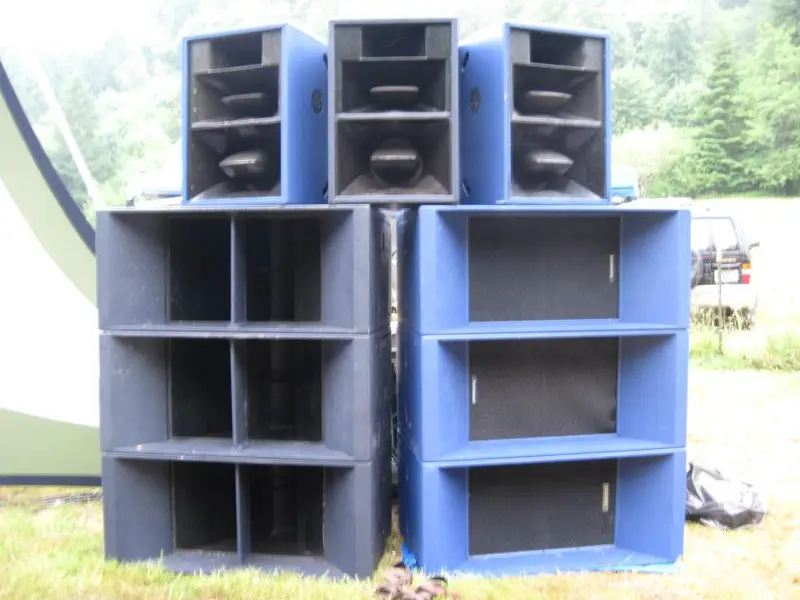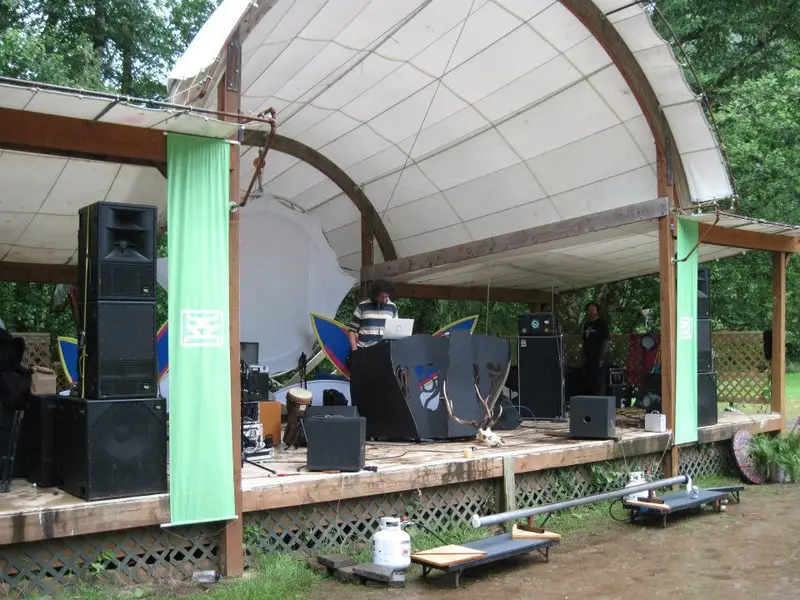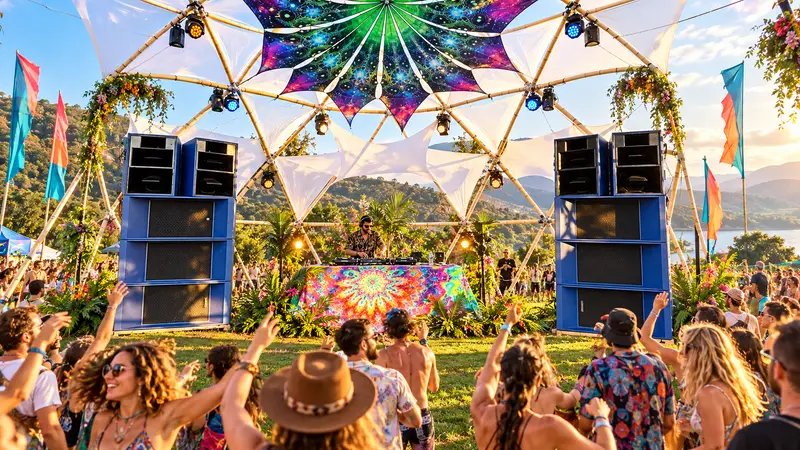
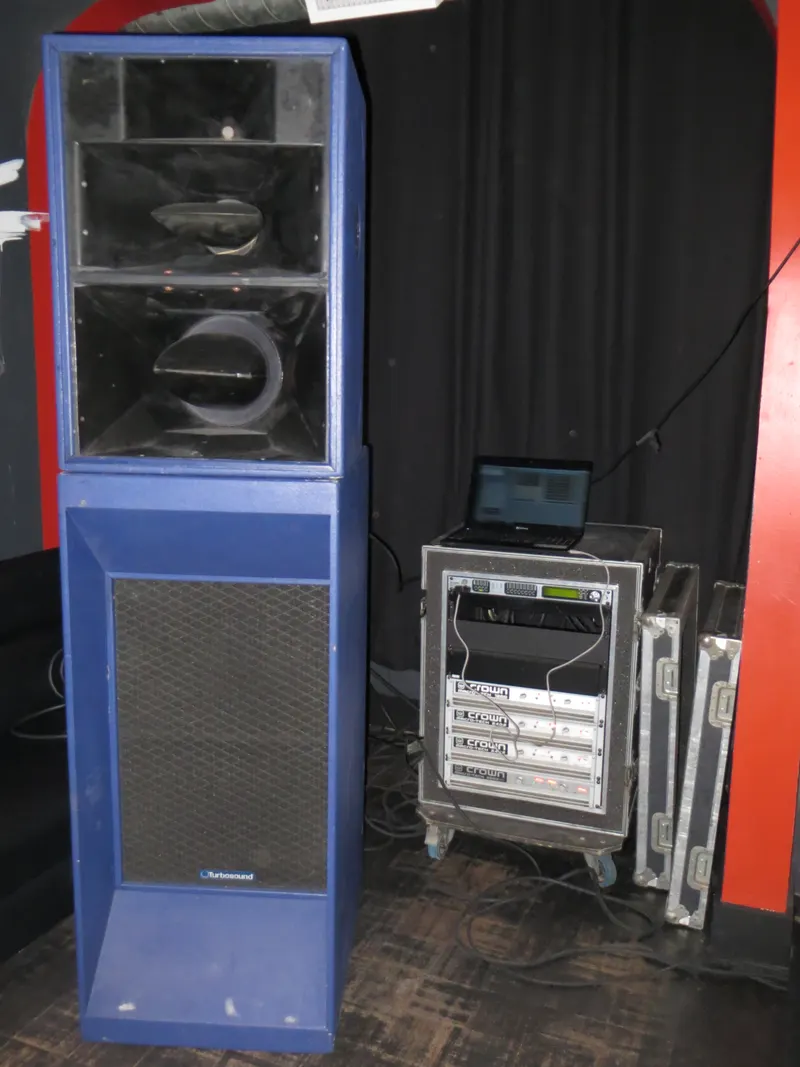
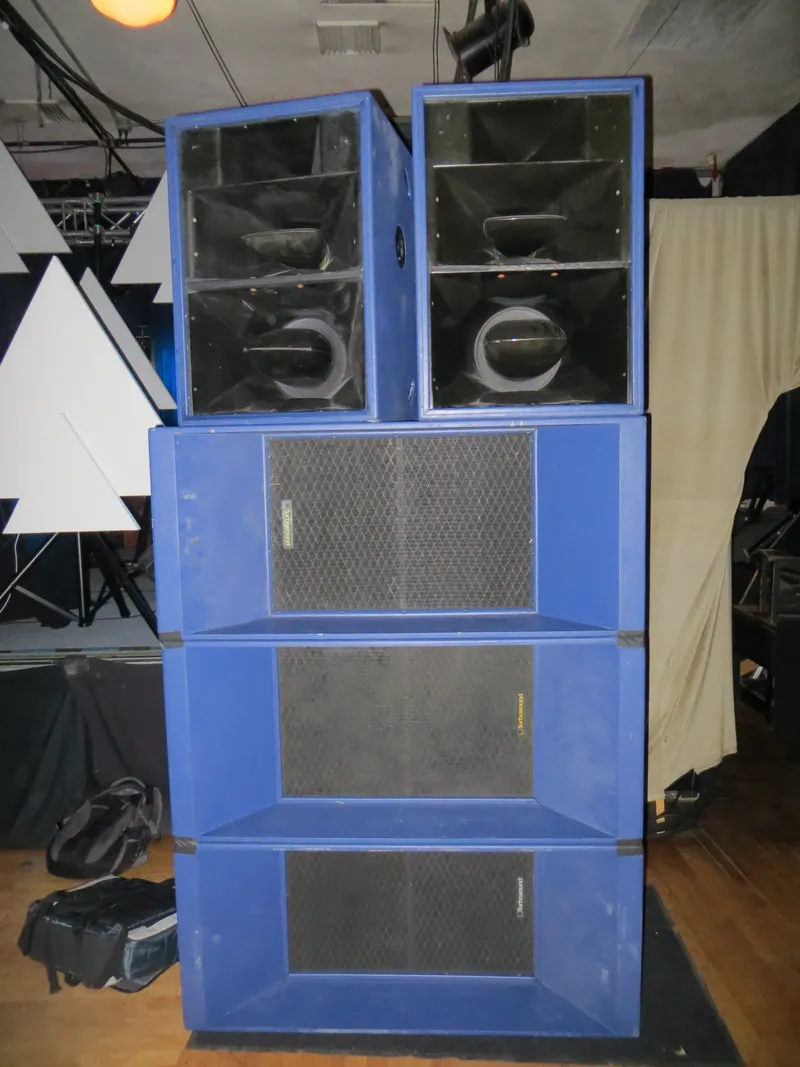
Strip away the black cable covers and road cases and a Mo’Pro Crew rig is four things: Turbosound Floodlight tops, horn-loaded subwoofer cabinets, amplifier racks and one mixer. Our smallest package ships with 2 tops and 2 dual-18 subs. Our biggest, Earthquake, ships with 4 tops and ten subs total. That is the whole stack, and this is a real walk through it, cabinet by cabinet.
We get asked “what’s actually in there?” more than almost any other question, usually by a groom standing next to a stack of cabinets at 2 p.m. on his wedding day, or a festival stage manager counting inputs. Here is the honest answer, in the order the truck unloads it.
The tops: three-way, horn-loaded, and why they go up top
The top cabinets are 3-way Turbosound Floodlight boxes. Three-way means separate drivers for lows, mids and highs inside the cabinet, instead of asking one or two drivers to cover the whole range. Horn-loaded means a shaped horn sits in front of those drivers to project the sound further and cleaner, without burning extra amplifier power to do it. We cover the engineering in more depth in Turbosound Floodlight explained, but the short version is: these are the cabinets doing the work on vocals, melody and anything a crowd sings along to.
They go on top of the stack for a reason that has nothing to do with looks. Mid and high frequencies are directional, so lifting them above head height lets the sound travel over a crowd instead of getting absorbed by the first few rows of people.
The subs: dual-18s, and dual-21s when the job calls for it
Underneath the tops sit the subwoofer cabinets, and this is where most of the stack’s actual size and weight comes from. Our standard subs are horn-loaded dual-18-inch cabinets: two 18-inch drivers per box, loaded into a folded horn instead of a simple ported box. A folded horn couples the driver to the room more efficiently, so the low end hits harder per watt instead of just getting louder and muddier. We go deep on why in horn-loaded subwoofers explained.
For the biggest jobs, we add dual-21-inch subs on top of that. Bigger drivers move more air at the lowest frequencies, which matters for outdoor crowds where there is nothing to bounce the sound back and reinforce it.
Here is exactly what ships in each package:
| Package | Price | Tops | Subs |
|---|---|---|---|
| Getting Bumping | $600 | 2x 3-way Floodlight tops | 2x dual-18 horn-loaded subs |
| Bit More Bass | $800 | 4x 3-way Floodlight tops | 4x dual-18 horn-loaded subs |
| Let’s Rumble | $1,000 | 4x 3-way Floodlight tops | 6x dual-18 horn-loaded subs |
| Earthquake | $1,600 | 4x 3-way Floodlight tops | 6x dual-18 subs + 4x dual-21 subs (10 subs total) |
Earthquake is built for crowds up to roughly 2,000 people. Let’s Rumble and Earthquake both carry a recommended setup window of 3 or more hours, because a stack that size has to go up safely, get wired correctly and get tuned to the room or field before a single song plays.
What’s actually hiding behind the cabinets
Nobody takes a photo of this part, but it is where the stack either works or doesn’t. Behind every tower of subs and tops sits:
- Amplifier racks. Powered cabinets still need clean power distribution and protection, run through racks built to travel, not sit in a studio.
- Signal and speaker cable, run in matched, labeled lengths so the same stack goes together the same way every time, whether it’s our crew’s 50th load-in or our 500th.
- One mixer, the single point where music, microphones for toasts or MC announcements, and any live inputs from a band all come together before they hit the amps.
This is the part of “production company” that a two-speaker Bluetooth rental can’t fake. It is also the part we will not cut corners on, because a sloppy cable run is how a system fails mid-event, and we have one shot at every single show.
Why the stack is the same every time
We are one crew running one rig. That is not a slogan, it is a scheduling fact: we book one event per day so the same people who own this gear are the ones loading it, wiring it and tuning it at your event. After 30 years in music and more than 100 events hosted, the stack you see at a backyard birthday is built from the exact same tops and subs as the stack at a 2,000-person festival stage, just fewer or more of them.
That consistency is also why we can hand you a price list with real cabinet counts instead of vague “professional sound system” language. You can read the sound system rental page and know precisely what shows up in the truck.
Stacking order, in practice
On a real load-in, the order is almost always:
- Subs go down first, positioned for coverage and, outdoors, angled or spaced to avoid canceling each other out.
- Tops go on stands or directly on the subs, angled down slightly toward the crowd, never straight out over everyone’s heads.
- Cable runs to the mixer position, usually front of house or just off to the side, kept out of foot traffic and taped down where it crosses a walkway.
- Power and gain get set, which is where tuning happens, matching the stack’s output to the room or field so it is loud enough at the back without being painful at the front.
None of this takes long once you have done it hundreds of times, but every step exists because skipping it has a real, audible cost.
Bigger than four cabinets
Not every event needs the smallest rig and not every event needs the biggest. A backyard party for 100 guests doesn’t need ten subwoofers, and a 1,500-person outdoor stage shouldn’t run on two. If you are not sure which stack your event actually needs, the sizing questions are the same ones we ask on every call: crowd size, indoors or outdoors, and whether there’s a live band or DJ pushing low end. We walk through that process in how to choose a PA system for your event.
See it stacked at your own event
The honest truth is that photos and spec sheets only go so far. The best way to understand what a Turbosound Floodlight stack feels like is to stand in front of one at your own party, wedding or festival stage. Check open dates and book online, and the crew that owns this gear will be the crew that shows up to stack it.
Every cable, every time.
Quick
answers.
What's actually in a Turbosound Floodlight stack?
Three-way horn-loaded Floodlight tops sitting on top of horn-loaded subwoofer cabinets, wired through amplifier racks into one mixer. Our smallest rig runs 2 tops and 2 dual-18 subs. Our largest, Earthquake, runs 4 tops and ten subs.
Do you own your gear or rent it from somewhere else for each job?
We own it. One crew, one rig, set up and tuned by the same people every time, not a rental counter handing you boxes.
How many subwoofers come with each package?
Getting Bumping has 2 dual-18 subs, Bit More Bass has 4, Let's Rumble has 6, and Earthquake adds 4 dual-21 subs on top of Let's Rumble's 6 dual-18s, for 10 subs total.
How long does it take to set up a full stack?
Our smaller packages set up well within a standard event window. Let's Rumble and Earthquake need 3 or more hours of setup time, which is why we build that into the booking.
Can I see the rig before I book?
The best way is to book a date and see it at your own event, but every package page lists the exact cabinet count so there are no surprises on load-in day.