Ask a DJ or a festival crew what makes a system feel great, and they will say the same thing: the low end. Not just how loud it is, but how it feels. Some subwoofers rumble. Some subwoofers punch. This is about the second kind.
Sound needs to move air
A subwoofer is a big speaker that reproduces low notes: the kick drum, the bass line, that thing your chest does at the drop. Low notes have very long wavelengths, and moving that much air takes either a lot of speaker or a smart cabinet.
Most subwoofers are built one of two ways.
Bass reflex (ported) subs
A ported cabinet has a tuned hole, or port, that lets air move in and out. The port helps boost a range of low frequencies. These cabinets are compact, relatively light and cost-effective. They are what most portable PA systems use, and they work well.
Horn-loaded subs
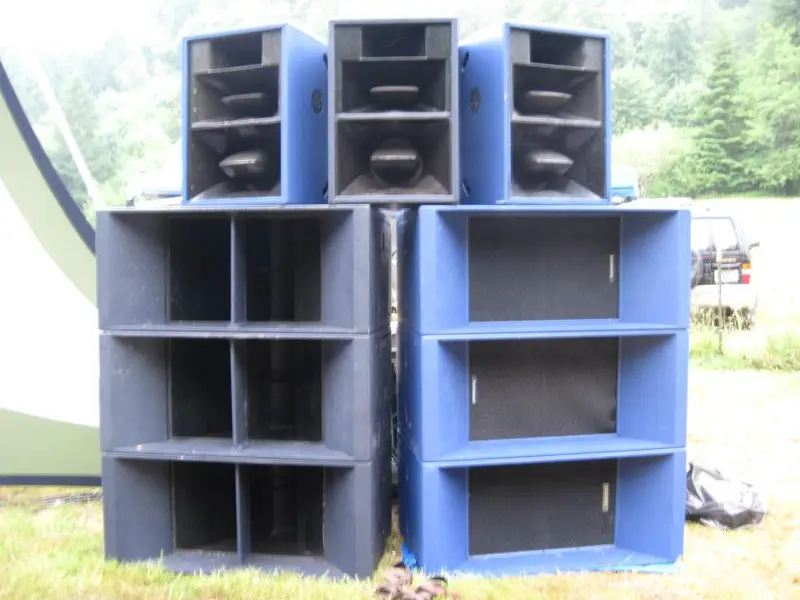
A horn-loaded sub does not rely on a port. The speaker sits at the small end of a horn, and the horn expands to a large mouth. It is often folded inside the cabinet because a full-size low-frequency horn would be enormous.
The horn works like an acoustic transformer. At the driver, the air is under high pressure with small movement. At the mouth, the air moves more with less pressure, which matches the open air better. Better matching means more of the driver’s energy makes it into the room.
What that means in practice
- Higher efficiency. For the same amplifier power, a horn-loaded sub can be several decibels louder than a comparable ported sub. Every 3 dB is a doubling of amplifier power.
- Punch. Horn-loaded bass tends to sound tight and fast, with a strong attack. Kick drums feel like kick drums.
- Lower distortion at volume. The driver works less hard, so it stays cleaner.
- Directionality. A horn shapes how the low end projects, which helps at outdoor shows.
- The trade-off: size. They are big, heavy cabinets. Setup takes more effort and more truck.
Why we run them
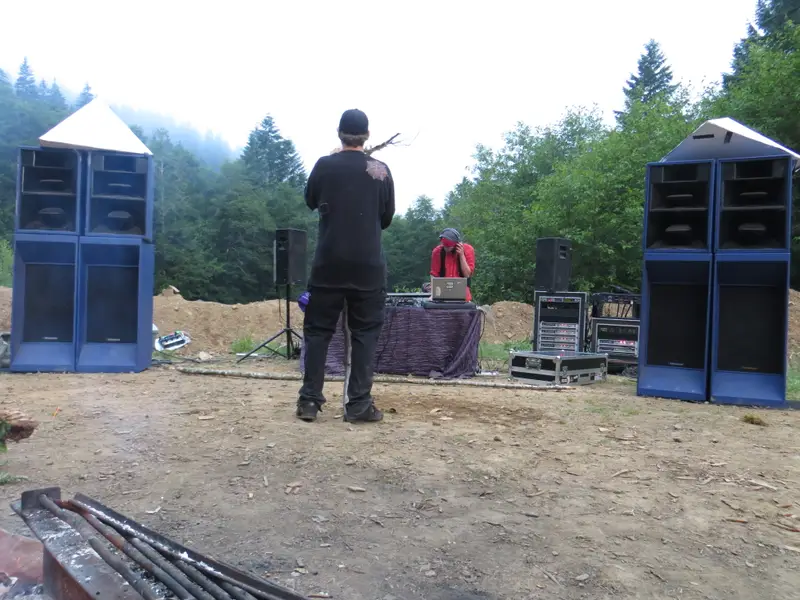
Our subwoofers are horn-loaded dual 18-inch cabinets, and it is why our packages feel bigger than their price suggests. At a party, that means:
- The dance floor can feel the beat without the tops being pushed too hard.
- Speech and vocals stay clear because the sub and tops are separately doing their jobs.
- You get a lot of low end without stacking up giant amplifier racks.
Bigger drivers: the 21-inch option
For the very lowest notes, larger drivers move more air. Our top package, Earthquake, adds four dual-21-inch subs on top of the Let’s Rumble setup for maximum low end. It is what you want for hip-hop, bass music and a big outdoor crowd.
Do I need horn-loaded subs?
You do if:
- You are throwing a dance party, festival or DJ night
- You want the low end to hit, not just be present
- You are outdoors and need coverage
You do not if:
- The event is a quiet dinner or a talk
- You only need light background music
- You have very little space or a tight load-in
Where the tech came from
Horn-loaded design has a long history in live sound. The Turbosound Festival System of the 1970s used folded-horn bass cabinets, and the approach carried on through designers like Tony Andrews at Funktion-One. Read that story in Tony Andrews: from Turbosound to Funktion-One, and see how the tops work in Turbosound Floodlight explained.
Rent the low end
Our packages start at $600 with two horn-loaded dual-18 subs and two Turbosound Floodlight tops, and scale up from there. See the subwoofer rental page or book online.

You feel it before you hear it.
Quick
answers.
What is a horn-loaded subwoofer?
It is a subwoofer whose driver sits inside a cabinet shaped like a long, folded horn. The horn couples the driver to the air more efficiently, producing more low-frequency output from the same power.
Are horn-loaded subs better than regular subs?
Better at some things. They are more efficient and hit harder per watt, but they are larger and heavier. Many other subs are more compact. It depends on the job.
Why are horn-loaded subs used at festivals?
Efficiency and impact. They deliver a lot of clean low end across a large crowd without huge amplifier banks.