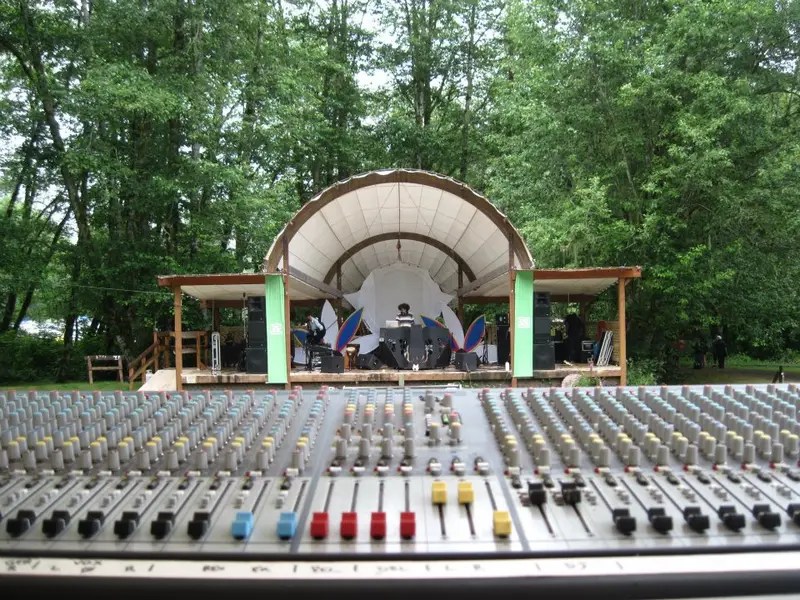
A front-of-house sound engineer is the person who mixes and actively manages a sound system in real time during a live event, working from a position out with the audience rather than on stage. They ride microphone levels during speeches, balance a live band’s instruments against the vocals, and adjust the whole system as the room fills and the night changes.
Why “front-of-house”
The name describes where they stand, not what they do. On a stage, a monitor engineer mixes what performers hear through their own speakers. Out in the room, the front-of-house engineer mixes what the audience hears. For most private events there’s just one engineer, and “front-of-house” is shorthand for “the person running the sound the crowd actually experiences.”
What they actually do during an event
A system that’s set up and tuned before the event starts still needs someone watching it once people arrive. Rooms change when they fill with bodies. A microphone that sounded fine in soundcheck can feed back the moment someone walks in front of a speaker. A live band’s volume balance shifts between songs. None of that fixes itself.
Over the course of an event, an engineer typically handles:
- Microphone levels during toasts, speeches and presentations, including catching a mic that’s about to feed back before it happens
- Live instrument balance, so a drummer doesn’t bury a vocalist and a bass player doesn’t overwhelm the room
- Overall volume, adjusted as the crowd grows, moves to the dance floor, or thins out later in the night
- Transitions, between a DJ set and a live set, or between background music and an announcement
- Troubleshooting, if a cable, a wireless mic or a piece of gear acts up mid-event
When you actually need one
A DJ running their own controller into a single stereo input is usually self-sufficient. There’s one source, no live instruments, and the DJ is already standing at the controls adjusting things as needed.
An engineer earns their cost once the input list grows. That includes:
- Live bands, where instruments and vocals all need independent levels
- Multiple wireless microphones, for toasts, presentations or a ceremony
- Corporate events with speakers, panels or Q&A segments
- Any event where the sound has to run unattended if the DJ or MC steps away
What it costs
Ours is a $75-an-hour add-on, billed for your event length plus one hour of soundcheck, with a 4-hour minimum. A 4-hour event bills 5 hours, for $375. A 6-hour event bills 7 hours, for $525. The math is simple on purpose: no separate “setup fee,” just an hourly rate with a floor.
| Event length | Billed hours | Cost |
|---|---|---|
| 4 hours | 5 (4-hour minimum + 1 hr soundcheck) | $375 |
| 5 hours | 6 | $450 |
| 6 hours | 7 | $525 |
| 8 hours | 9 | $675 |
Add it when you book a sound system rental package, or ask about it for a corporate event or live band.
What happens without one
Nothing dramatic, usually. The system plays. The event happens. But a mic that’s a little hot during a toast, a band that’s mixed a little muddy, or a room that gets a little too loud once it fills, none of that gets caught and fixed in the moment without someone watching for it. The event still works. It just isn’t tuned to the actual room, in real time, the whole night.
The honest tradeoff
If your event is a DJ and a dance floor with nothing else plugged in, you likely don’t need this. If your event has toasts, a live band, multiple microphones, or has to run smoothly whether or not the host is paying attention to the sound board, an engineer is the cheapest insurance on the invoice relative to what goes wrong without one.
See our sound engineer for hire page for the full add-on details, or send us your event type and guest count and we’ll tell you plainly whether we’d recommend one for your specific event.
A great system with nobody watching it is just expensive furniture.
Quick
answers.
Do I need a sound engineer for a DJ with a laptop?
Usually not. A DJ running their own controller or laptop into one stereo input is typically self-sufficient. An engineer earns their cost when there are multiple inputs, live musicians, or wireless mics to manage.
What does front-of-house actually mean?
It refers to the mixing position out with the audience, as opposed to the stage or monitor position. "Front-of-house engineer" and "FOH engineer" both mean the person mixing what the crowd hears.
How much does a sound engineer cost?
Ours is $75 an hour, billed for the event length plus one hour of soundcheck, with a 4-hour minimum. A 4-hour event runs 5 billed hours, or $375.
Can the engineer also run our sound system for a wedding or corporate event?
Yes. Toasts, presentations, live music segments and open dancing all benefit from someone actively managing levels rather than a system left on a fixed setting.