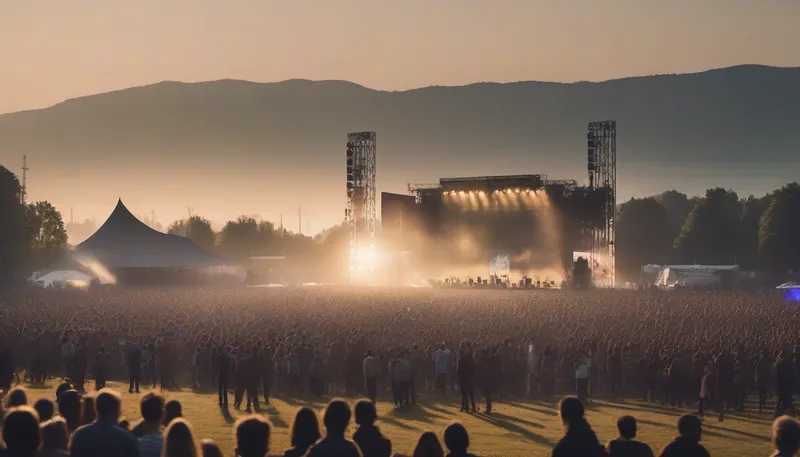
A delay tower is an extra speaker placed farther back in a crowd, fed the same sound as the main speakers and timed so it lines up with the sound arriving from the stage. Events use them because sound fades with distance and travels slowly. Without delays, a long outdoor crowd gets a loud front and a thin, unclear back.
Here is how they work, when an event needs them, and what to ask your sound provider.
The two problems delay towers solve
Sound fades with distance. For a speaker in open air, every doubling of distance drops the level by about 6 dB. At 25 feet you might hear it at full strength. At 100 feet it has dropped twice, and at 200 feet three times. In a room, walls help. Outdoors, nothing does.
Sound is slow. It travels at about 1,125 feet per second, which is roughly one foot per millisecond. That sounds fast, but across a field it adds up. A listener 200 feet from the stage hears the mains about 175 milliseconds after they play.
What a delay tower does about it
A tower is placed partway back in the crowd. It plays the same program as the mains, but the console or processor holds the signal back by the time it takes sound to travel from the stage to the tower. That way, the tower’s sound and the stage’s sound arrive together.
If you skipped the delay, the tower would play too early. The listener would hear the tower first, then the stage a moment later, as an echo. With the delay set, both blend as one source, and the tower simply gives the back rows more level and clarity.
How the layout looks
| Zone | What covers it |
|---|---|
| Front to mid crowd | Mains and subs at the stage |
| Mid to back crowd | Delay speakers on stands or towers partway back |
| Very long or wide crowds | More than one delay zone, sometimes on the sides |
Subs are often left at the stage. Low frequencies spread widely, so adding delayed subs is a more specific choice.
When an event needs them
The question is depth and layout, not just headcount. Look at these:
- How far is the farthest guest from the stage? The farther, the more likely you need coverage beyond the mains.
- Is the crowd long and narrow, or wide and shallow? A shallow crowd is easier.
- Is there anything blocking the sound? Tents, trees and structures can shadow the back.
- How loud do you need it at the back? A relaxed gathering is more forgiving than a dance event.
If you are unsure, ask your provider to show you the coverage plan. Our guide on how many speakers an outdoor party needs covers the basic sizing rules, and how festival sound systems work shows where delays fit with the rest of the rig.
What not to do
- Do not just turn the mains up. The front row pays for it and the back row is still thin.
- Do not place delays without timing them. An untimed tower produces an echo.
- Do not point speakers at the sky. Aim them at the audience.
What it means for your budget
Our standard packages cover crowds up to about 1,000 people (Let’s Rumble, $1,000) and about 2,000 people (Earthquake, $1,600), set up at the stage, with delivery within 15 minutes of downtown Austin. Jobs that need delay towers, more than one stage or multiple zones are quoted individually, with an engineer to set them up. Sound engineers are $75 an hour with a 4-hour minimum and a 1-hour soundcheck.
To talk through a large outdoor event, see our festival sound system rental page or send the details on the booking page.
Sound is slow. A good rig plans for that.
Quick
answers.
What is a delay tower?
A delay tower is a speaker positioned farther back in a crowd, fed the same audio as the main speakers but timed so it matches the sound arriving from the stage. It keeps the back of a long crowd from losing clarity and level.
Why do delay speakers have to be timed?
Sound travels at about 1,125 feet per second, roughly a foot per millisecond. A speaker 200 feet from the stage would play ahead of the stage sound unless it is delayed to match. Without the delay, listeners would hear an echo.
How big does a crowd need to be before delays matter?
It depends on the depth of the crowd more than the headcount. A crowd that stretches far from the stage is the trigger, and we plan it job by job.
Do your packages include delay towers?
Our standard packages cover crowds up to about 1,000 and 2,000 people from the stage. Jobs that need delays, multiple zones or several stages are custom and quoted.
Is more volume the answer instead?
No. Turning up the mains to reach the back makes the front uncomfortable and still leaves the back thin. Delays solve it by adding coverage.