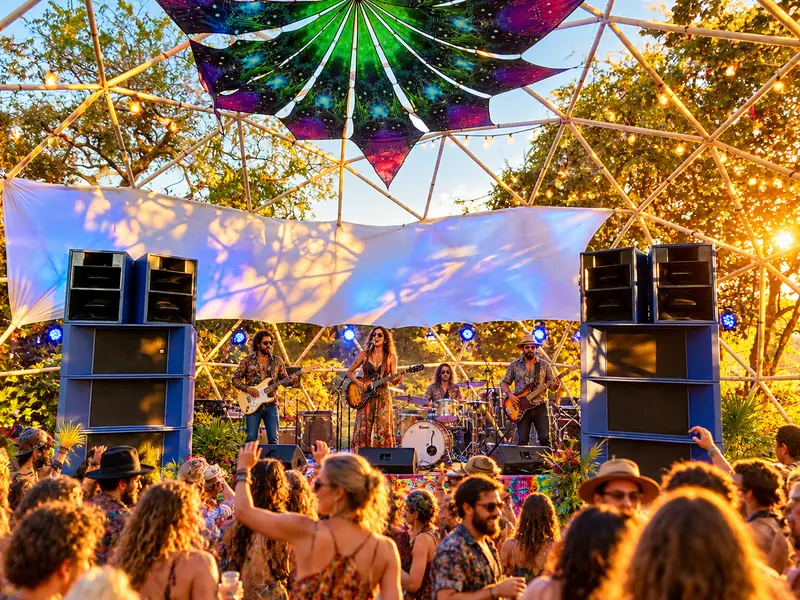
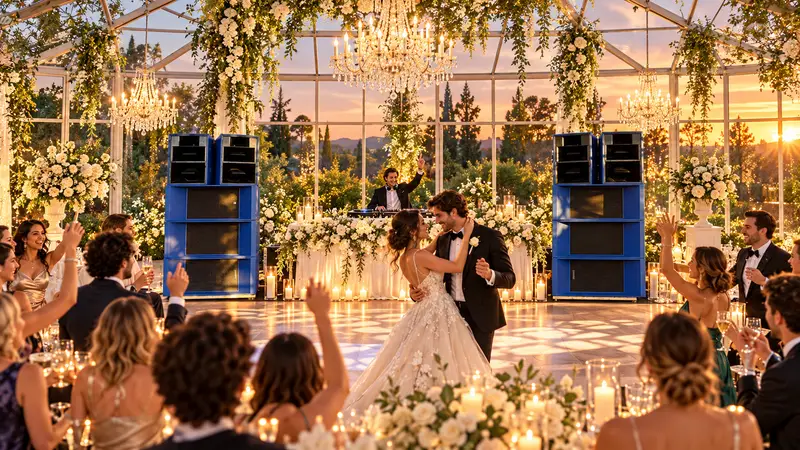
Most wedding receptions run four to five hours of DJ time, from cocktail hour to the last song. Inside those hours, the night follows a shape: eight moments, in close to the same order, at nearly every reception we run. Here is a real sample timeline showing how they stack up.
Why every reception has roughly the same shape
A wedding reception looks different from couple to couple. The venue changes, the guest list changes, the music changes. But the structure underneath is remarkably consistent, because it is built around a handful of things that have to happen in a specific order: people need to eat, someone has to make a toast, the couple needs their first dance before the room gets too loose, and the dancing needs enough runway to actually build.
That structure is cocktail hour, grand entrance, first dance, toasts, dinner, cake and traditions, open dancing, and the last song. A good DJ plans every one of those moments with the couple weeks in advance, then runs them as the MC on the day.
A sample timeline, hour by hour
This is a sample based on a 6-hour booking that covers the ceremony through the send-off, similar to our Full Day wedding package. It is one way the day could run, not a fixed script. Every real timeline gets built around the actual ceremony time, venue layout and guest count.
3:30 PM. Ceremony music. Prelude music plays as guests arrive and find seats, then the processional cues the wedding party and the bride down the aisle. If the ceremony and reception share a sound system, this is also when the officiant’s lapel mic goes live.
4:00 PM. Ceremony. Vows, the ring exchange, the kiss. Short, quiet, and the one part of the day where the sound system’s only job is to be heard clearly and stay out of the way.
4:30 PM. Cocktail hour. Background music at conversation level while guests mingle, take photos and find their seats for dinner. This is also when the band or DJ usually finishes converting the ceremony setup into the reception setup if it is the same space.
5:30 PM. Grand entrance. The wedding party is announced first, building to the couple’s entrance on a big song. This is the DJ’s first real moment as MC, and it sets the tone for the room.
5:40 PM. First dance. A clean mix with no interruptions. Most couples want this moment handled simply: the song plays, nothing else competes with it.
5:45 PM. Welcome toasts. Wireless microphones for the parents or wedding party members speaking. Clear speech matters more here than volume. For more on what to check with your DJ before the day, see our questions to ask a wedding DJ.
6:00 PM. Dinner. Warm, low background music that lets people talk at the table. The DJ is watching the room and the catering timeline, not playing requests yet.
6:45 PM. Parent dances. Often back to back, sometimes combined into one song for both. Another moment that benefits from a plan, not improvisation.
7:00 PM. Cake cutting. A short, cued moment, usually right before the energy shifts toward dancing.
7:15 PM. Open dancing begins. The DJ starts building, not peaking immediately. A classic track into a current hit keeps the generations in the room together on the floor.
8:30 PM. Peak hour. This is where the night usually lands its best stretch, and where a real sound system earns its keep. A dance floor built on weak sound stalls here no matter how good the song selection is.
9:25 PM. Last song. A send-off track people remember, announced ahead so guests know it is coming.
9:30 PM. End of coverage.
That is six hours end to end. A standard 5-hour reception package runs the same shape starting at cocktail hour, without the ceremony block at the front.
What actually moves on the day
Timelines are a plan, not a guarantee. In our experience running these nights, three things shift most often:
Dinner service runs long. Caterers do not always hit their own schedule. A good DJ holds dancing until the room is actually ready, not at a fixed clock time.
The dance floor wants more time. If the room is still full at the scheduled last song, a DJ can often stretch open dancing by trimming elsewhere, with the couple’s sign-off.
A moment gets combined or dropped. Garter and bouquet tosses are the most commonly skipped pieces now. Parent dances occasionally get combined into one song to save time without losing the moment.
None of that works without an MC who is paying attention to the room, not just the clock. That is the actual job behind the DJ booth: see our breakdown of what a DJ does at a wedding reception for the rest of it.
The sound behind the timeline
The timeline only works if the sound system can do two very different jobs in the same room. Dinner and toasts need clear, even coverage without hot spots near the speakers. Open dancing needs real low end that fills the room without distorting.
We run our own Turbosound Floodlight rig with horn-loaded subwoofers on every wedding, which is one reason the handoff from dinner-quiet to dance-floor-loud happens without a wobble. One crew owns the gear, sets it, and runs it start to finish, so there is nobody to blame if a cable gets kicked or a sub goes missing. In 30 years in music and live sound and more than 100 events hosted, the pattern that holds up every time is the same: the timeline is only as good as the sound and the person running it.
Building your own timeline
A few questions worth answering early with your DJ:
- Where does the ceremony happen relative to the reception? Same room, different room same venue, or a different venue entirely all change the setup time built into the schedule.
- How many speeches, and how long? Four short toasts move faster than two long ones. Either is fine, but the DJ needs to know going in.
- Which traditions matter to you? Parent dances, a religious or cultural ritual, a specific exit. Name them early so they get a real slot, not an afterthought.
- What is the real end time? Many venues have a hard cutoff. Build backward from that time, not forward from the ceremony.
- Who is the point of contact on the day? Usually the DJ/MC, sometimes a planner. One person should own the clock.
Compare that against what a DJ actually costs in Austin and whether a DJ or a live band fits your reception better, and you will have most of what you need to build a real timeline instead of guessing at one.
Ready to build yours?
We build the timeline with you as part of booking, not as an extra step. Pick a package on the wedding DJ packages page, or go straight to the wedding reception DJ page to check your date.
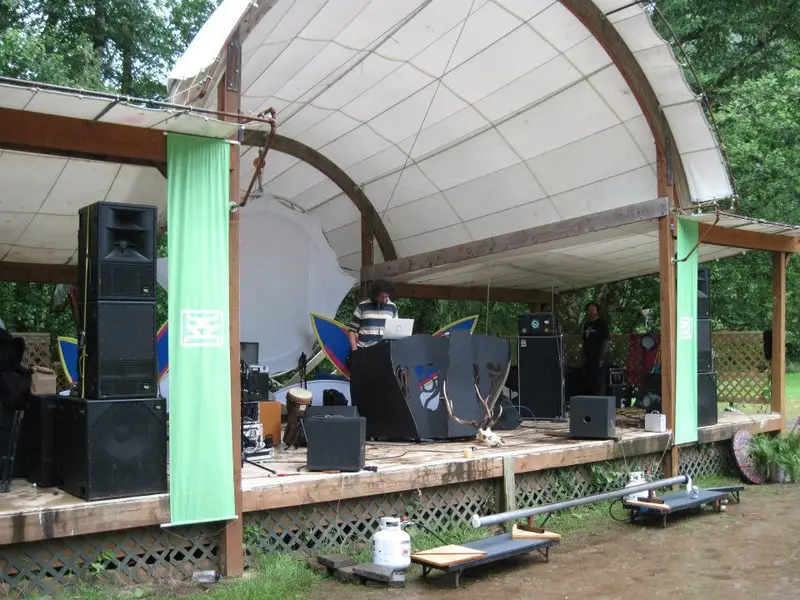
Every one of those moments was planned weeks before the wedding.
Quick
answers.
How long does a wedding reception DJ timeline run?
Most wedding receptions run four to five hours of DJ time, not counting setup. That covers cocktail hour through the last song. Longer packages, like a 6-hour ceremony-to-send-off booking, add the ceremony and more cocktail hour on the front end.
What order do wedding reception moments usually go in?
The common order is cocktail hour, grand entrance, first dance, toasts, dinner, parent dances, cake and traditions, open dancing, and the last song. Couples can move pieces around, but most timelines follow close to that shape.
Who decides when each moment happens on the day?
The DJ, acting as MC, calls each cue in real time based on the plan built in advance with the couple. Dinner service, photographer needs and how long a dance floor is still going can all shift the exact minute something happens.
Does cocktail hour count toward the DJ's booked hours?
Usually yes. A standard 5-hour reception package typically starts the clock at cocktail hour and runs through the last dance. If the ceremony is at the same venue, a 6-hour ceremony-to-send-off package covers that too.
What happens if the timeline runs behind?
An experienced DJ adjusts on the fly, usually by trimming open dancing time or combining announcements, not by cutting toasts or the first dance short. That is part of why the MC and the DJ are the same person at most receptions.